
Simplicity and Accountability
Common SenseThis flow traces Paine’s theme that simple political arrangements make authority easier to understand, judge, and repair.
increasing Bearing strength in each event
 decreasing
Bearing strength in each eventdecreasingA Principle of Simplicity
A Principle of Simplicity
Fewer Points of Failure
Paine argues that simple things are less liable to disorder. When problems arise, a simpler structure is easier to repair.
Political Application
He applies this principle to government, where complexity can conceal responsibility. Institutional design should make failures visible rather than mysterious.
Complexity Clouds Blame

Complexity Clouds Blame
Causes Multiply
The English constitution divides authority among several powers. When the public suffers, people can disagree about which part is responsible.
Remedy Delayed
Confusion over cause produces disagreement over cure. Complexity can prolong public hardship by making action less direct.
Checks Become Contradictions

Checks Become Contradictions
Competing Powers
The commons checks the king through supplies, while the king checks the commons through veto. Paine argues that this arrangement gives opposing claims without a clear principle of public accountability.
Balance Under Strain
The language of mutual restraint sounds orderly, but the institutions can undermine one another. Paine asks which power actually commands the system.
Weight Determines Rule
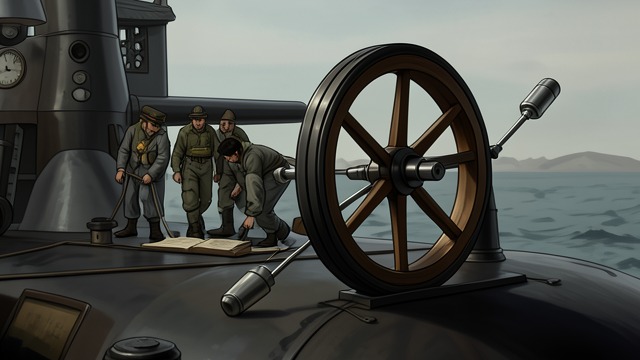
Weight Determines Rule
Motion and Power
Paine compares the constitution to a machine in which the strongest moving part determines the direction. Other parts may slow its motion without stopping it.
Influence Beneath Form
The analogy shifts attention from written design to practical power. The effective ruler is the institution capable of prevailing over the others.
Repair Through Public Clarity

Repair Through Public Clarity
Responsibility Made Legible
A simpler government allows citizens to see where authority lies and who must answer for failure. Public understanding becomes a condition of accountability.
Design for Correction
The point of simplicity is not elegance alone. Institutions should allow people to correct errors before those errors harden into oppression.
As Paine introduces his standard for political design
During Paine’s criticism of England’s constitution
As Paine tests the claim of reciprocal constitutional balance
During Paine’s machine analogy
At the close of the constitutional critique
